
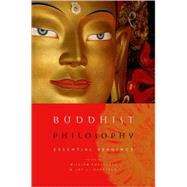
Buddhist Philosophy Essential Readings
by Edelglass, William; Garfield, JayFormat: Paperback
Pub. Date: 2009-04-21
Publisher(s): Oxford University Press
 Other versions by this Author
-

Receive Free Shipping To The More Store!*
*Marketplace items do not qualify for the free shipping promotion.
-
 eCampus.com Device Compatibility Matrix
Click the device icon to install or view instructions
 Apple iOS | iPad, iPhone, iPod
 Android Devices | Android Tables & Phones OS 2.2 or higher | *Kindle Fire
 Windows 10 / 8 / 7 / Vista / XP
 Mac OS X | **iMac / MacbookEnjoy offline reading with these devicesiPad, iPhone, iPod
 Android 2.2 +Kindle FireWindows
10 / 8 / 7 / Vista / XPMac


List Price: $51.19
Buy New
In Stock
$51.14
Rent Textbook
Select for Price
Digital
$29.99*
Used Textbook
We're Sorry
Sold Out
How Marketplace Works:
- This item is offered by an independent seller and not shipped from our warehouse
- Item details like edition and cover design may differ from our description; see seller's comments before ordering.
- Sellers much confirm and ship within two business days; otherwise, the order will be cancelled and refunded.
- Marketplace purchases cannot be returned to eCampus.com. Contact the seller directly for inquiries; if no response within two days, contact customer service.
- Additional shipping costs apply to Marketplace purchases. Review shipping costs at checkout.
Summary
The Buddhist philosophical tradition is vast, internally diverse, and comprises texts written in a variety of canonical languages. It is hence often difficult for those with training in Western philosophy who wish to approach this tradition for the first time to know where to start, anddifficult for those who wish to introduce and teach courses in Buddhist philosophy to find suitable textbooks that adequately represent the diversity of the tradition, expose students to important primary texts in reliable translations, that contextualize those texts, and that foregroundspecifically philosophical issues. Buddhist Philosophy fills that lacuna. It collects important philosophical texts from each major Buddhist tradition. Each text is translated and introduced by a recognized authority in Buddhist studies. Each introduction sets the text in context and introduces the philosophical issues it addressesand arguments it presents, providing a useful and authoritative guide to reading and to teaching the text. The volume is organized into topical sections that reflect the way that Western philosophers think about the structure of the discipline, and each section is introduced by an essay explainingBuddhist approaches to that subject matter, and the place of the texts collected in that section in the enterprise. This volume is an ideal single text for an intermediate or advanced course in Buddhist philosophy, and makes this tradition immediately accessible to the philosopher or student versed in Western philosophy coming to Buddhism for the first time. It is also ideal for the scholar or student ofBuddhist studies who is interested specifically in the philosophical dimensions of the Buddhist tradition.
Author Biography
William Edelglass is Assistant Professor of Philosophy at Marlboro College. Previously he taught at the Institute of Buddhist Dialectics, Dharamsala, India. His research focuses on Buddhist philosophy, environmental philosophy, and twentieth century continental philosophy.
Jay Garfield is Doris Silbert Professor in the Humanities and Professor of Philosophy at Smith College. His books include the translations of Nagarjuna's Mulamadhyamakakarika: The Fundamental Wisdom of the Middle Way (OUP, 1995); Tsong khapa's Ocean of Reasoning (OUP, 2002), and Empty Words: Buddhist Philosophy and Cross-Cultural Interpretation (OUP, 2006).
Table of Contents
| Contributors | p. xv |
| Introduction | p. 3 |
| Metaphysics and Ontology | p. 9 |
| Therav&abar;da Metaphysics and Ontology: Kacc&abar;nagotta (Samyutta-nik&abar;ya) and Abhidhammatthasangaha | p. 13 |
| N&abar;g&abar;rjuna's Mulamadhyamakak&abar;rik&abar; (Fundamental Verses of the Middle Way): Chapter 24: Examination of the Four Noble Truths | p. 26 |
| Vasubandhu's Trisvabh&abar;vanirdesa (Treatise on the Three Natures) | p. 35 |
| Santaraksita's "Neither-One-Nor-Many" Argument from Madhyamakalamkara (The Ornament of the Middle Way): A Classical Buddhist Argument on the Ontological Status of Phenomena | p. 46 |
| Mipam Namgyel: The Lion's Roar Affirming Extrinsic Emptiness | p. 61 |
| Dushun's Huayan Fajie Guan Men (Meditative Approaches to the Huayan Dharmadhatu) | p. 73 |
| D&obar;gen's "Mountains and Waters as S&ubar;tras" (Sansui-ky&obar;) | p. 83 |
| Nishitani Keiji's "The Standpoint of Zen: Directly Pointing to the Mind" | p. 93 |
| Philosophy of Language and Hermeneutics | p. 103 |
| Sensation, Inference, and Language: Dign&abar;ga's Pram&abar;nasamuccaya | p. 107 |
| Jñ&abar;nagarbha's Verses on the Distinction between the Two Truths | p. 116 |
| Language and the Ultimate: Do M&abar;dhyamikas Make Philosophical Claims? A Selection from Khedrupjey's Stong thun chen mo (Great Digest) | p. 126 |
| Zongmi's Yuanren lun (lnquiry into the Origin of the Human Condition): The Hermeneutics of Doctrinal Classification | p. 138 |
| D&obar;gen's Sh&obar;b&obar;genz&obar;, Fascicles "Katt&obar;" and "&Obar;sakusendaba" | p. 149 |
| Beyond Awareness: T&obar;rei Enji's Understanding of Realization in the Treatise on the Inexhaustible Lamp of Zen, chapter 6 | p. 159 |
| Epistemology | p. 171 |
| The Approach to Knowledge and Truth in the Therav&abar;da Record of the Discourses of the Buddha | p. 175 |
| Dharmak&ibar;rti and Dharmottara on the Intentionality of Perception: Selections from Nyayabindu (An Epitome of Philosophy) | p. 186 |
| The Role of Knowledge of Causation in Dharmakirti's Theory of Inference: The Pramana-varttika | p. 197 |
| Yog&abar;c&abar;ra Theories of the Components of Perception: The Buddhabh&ubar;my-upadeśa | p. 205 |
| Classification of Non-Authoritative Cognitive Processes (tshad min) in the Ngog and Sakya Traditions | p. 218 |
| Understanding the Two Truths: Tsongkhapa's Ocean of Reasoning: A Great Commentary on N&abar;g&abar;rjuna's "M&ubar;lamadhyamakak&abar;rik&abar;" | p. 224 |
| The Deluded Mind as World and Truth: Epistemological Implications of Tiantai Doctrine and Praxis in Jingxi Zhanran's Jingangpi and Zhiguan yili | p. 238 |
| The Presencing of Truth: Dogen's Genj&obar;k&obar;an | p. 251 |
| Philosophy of Mind and the Person | p. 261 |
| Therav&abar;da Philosophy of Mind and the Person: Anatta-lakkhana Sutta, Mah&abar;-nid&abar;na Sutta, and Milindapanha | p. 265 |
| Pudgalav&abar;da Doctrines of the Person | p. 275 |
| Vasubandhu's Abhidharmakosa: The Critique of the Pudgalav&abar;dins' Theory of Persons | p. 286 |
| Vasubandhu's Abhidharmakośa: The Critique of the Soul | p. 297 |
| Candrak&ibar;rti's Madhyamak&abar;vat&abar;rabh&abar;sya 6.86-97: A Madhyamaka Critique of Vijñ&abar;nav&abar;da Views of Consciousness | p. 309 |
| Ś&abar;ntaraksita's Tattvasamgraha: A Buddhist Critique of the Ny&abar;ya View of the Self | p. 320 |
| Zhiyi's Great Calming and Contemplation: "Contemplating Mental Activity as the Inconceivable Realm" | p. 334 |
| "The Mind Is Buddha": Pojo Chinul's Secrets on Cultivating the Mind | p. 348 |
| Nishida's Conception of Person | p. 358 |
| Ethics | p. 371 |
| Therav&abar;da Texts on Ethics | p. 375 |
| The Bodhisattva Path: Ś&abar;ntideva's Bodhicary&abar;vat&abar;ra | p. 388 |
| Asanga's Bodhisattvabh&ubar;mi: The Morality Chapter | p. 400 |
| Essentials on Observing and Violating the Fundamentals of Bodhisattva Precepts: Wonhyo's Non-Substantial Mah&abar;y&abar;na Ethics | p. 409 |
| Thich Nhat Hanh's Interbeing: Fourteen Guidelines for Engaged Buddhism | p. 419 |
| Joanna Macy: The Ecological Self | p. 428 |
| Buddhist Feminist Reflections | p. 437 |
| Index | p. 449 |
| Table of Contents provided by Ingram. All Rights Reserved. |
An electronic version of this book is available through VitalSource.
This book is viewable on PC, Mac, iPhone, iPad, iPod Touch, and most smartphones.
By purchasing, you will be able to view this book online, as well as download it, for the chosen number of days.
Digital License
You are licensing a digital product for a set duration. Durations are set forth in the product description, with "Lifetime" typically meaning five (5) years of online access and permanent download to a supported device. All licenses are non-transferable.
More details can be found here.
A downloadable version of this book is available through the eCampus Reader or compatible Adobe readers.
Applications are available on iOS, Android, PC, Mac, and Windows Mobile platforms.
Please view the compatibility matrix prior to purchase.